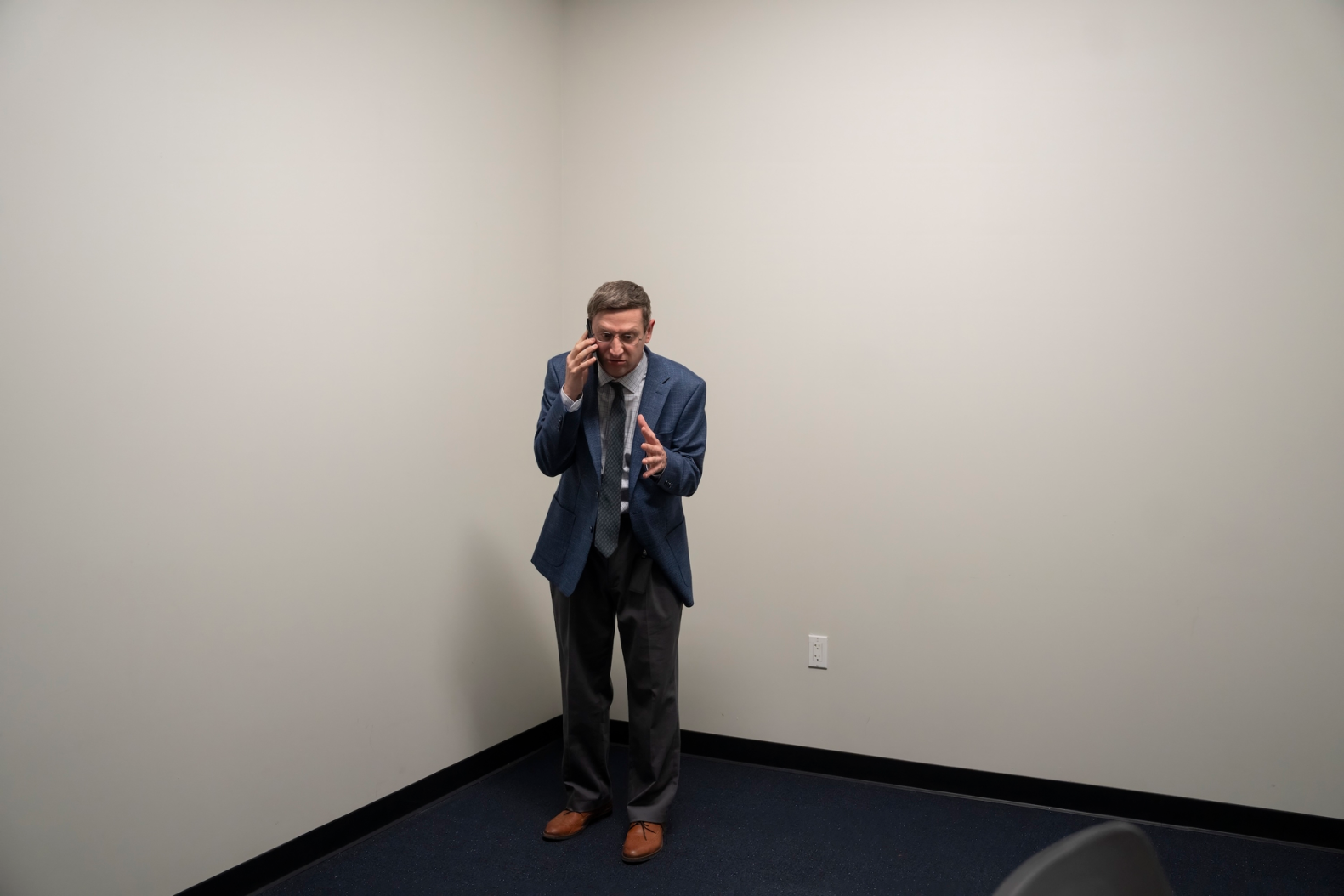
The premiere of Tim Robinson’s The Chair Company (TCC) had the highest viewership of any HBO comedy since 2020. COVID-era TV statistics are like if Barry Bonds took double-steroids; we were watching whatever slop they churned out, as it was our civic duty to do so. That is to say, a lot of people were stoked for this show. And rightfully so. Tim Robinson seems to get what makes weird and awkward shit funny, and plus, millennials always need something new to try on at Catan night. With TCC being a standard-format TV show, rather than the quick sketches of I Think You Should Leave, Robinson has the room to go deeper into the personal histories and social dynamics that make his characters so bizarre. This time, Robinson does this with a sharper critical edge than we’ve seen from him.
His protagonist, Ron Trosper, lives a tidy, Midwestern, fantasy life as a mid-level manager at a retail development firm, Fisher-Robay, heading up a new environmentally conscious mall. The point at which we meet him is actually after he has returned to Fisher-Robay following the failure of his American Dream: creating a Jeep tour in suburban Ohio, designed to be “therapy for soldiers… So they still live on the edge but it’s not all as dangerous as war.” In a flashback, we see that both Ron and his wife, Barb, quit their jobs in an exciting “taking back our life!” moment, expressing some Utopian impulse. Obviously, the idiocy of Ron’s endeavor is partly for comedic effect, but it also highlights the inherent futility in Ron’s specific dream. At this point, it is a trope to see a 40-something character discontent and void of life-affirming purpose, but instead of having his characters go on a life-changing journey to show that there is a way to find meaning within the status quo structures, Robinson shows us life after this ridiculous attempt has already failed. It is even further emphasized by both Ron and Barb’s dreams being entrepreneurial, showing that the Utopian impulse to find something more has been subsumed by capitalism and its ever-expanding horizon. Any attempt to transcend these conditions of discontentment that is contained within the system itself is bound to failure before it’s even begun.
After the failure of his Jeep tours, in part because his potential investors wanted him to affix screens with CGI dinosaurs to the inside of the jeep, Ron is back at Fisher-Robay attempting to rebuild the facade of satisfaction with his new Canton, OH, mall project. During the big meeting, Ron’s chair collapses from underneath him, and with it, the facade topples. This symbolic moment of trauma sets him forth on a paranoid investigation into an array of cryptic symbols popping up around him, all centering on a mysterious chair company called Tecca. While his obsession with the conspiracy seems to put him at odds with his family (although they remain devoted and supportive, on the surface, at least), it is more important to view this as a point of contrast to the broader status quo of Ron’s life. If we see the Utopian as “a position of radical Difference in the face of the Identity of the everyday,” then this is the expression of Ron’s Utopian impulse, not the Jeep tours. His investigation into a corporate conspiracy is what allows Ron to position himself outside of the established order of things, unlike his impulse to start a business, which is contained within capitalism’s logic. However, TCC’s internal logic suggests that there may be nothing here other than Ron’s futile, self-destructive search for meaning; maybe there is no truth to be found.
In the penultimate episode of the season, we are lulled into a false sense of resolution: that there was a legitimate conspiracy at the center of Ron’s spiraling investigation; that Alice, Barb’s angel investor, was only interested in Everpump to keep Ron quiet about her replacing Tecca chair parts and reselling the chairs. If the show had ended here, we would have been left with what may have felt like a happy ending: Ron sacrificed his destructive obsession for the sake of his love of Barb and their family. However, a more critical reading uncovers the despair here: Ron’s efforts found real truth about corporate corruption, but his desire to expose the conspiracy was swallowed by the promise of capital via Alice’s investment.
Ron’s examination into the concealed content of Tecca represents a symbolic attempt to examine the “under-content” of our real social life: all of the constitutive elements of late-capitalism that are combed and rewritten into a bearable narrative; things that we can never truly approach in real life. As Jameson puts it, “[History] is inaccessible to us except in textual form…our approach to it and to the Real itself necessarily passes through its prior textualization.” This “textualization” is always ideological. We can't look at what is really there, but only the shadows cast, the effects on the things around it, the way it has been “written” into the “historical” record. On the level of cultural “texts” themselves (movies, TV, literature, etc.), a critical reading can present some kernel of political truth that is drawn out of that specific creative work via the “shadows” of History that were cast onto the text itself. The same is true for the way we perceive the world around us; we must critically “read” these “texts” to draw out the shadows of the unapproachable, but necessary, truth of our social world.
This is one of the valuable aspects of fiction: it can provide a symbolic resolution to real contradictions that cannot be resolved in our current conditions of reality. However, in episode 7, as I mentioned, TCC extinguishes even this symbolic potential. In the season finale, it seems to abandon resolution altogether, favoring total ambiguity. Robinson introduces a variety of contradictory plots, none of which seem more plausible than the others, with the show ending on a freeze frame of Ron’s comically confused face. Perhaps this turn towards fragmentation is to even further highlight the false promise of the previous episode’s “resolution.”
In fact, the ambiguous ending, in which the threads of “meaning” are only multiplying, can serve as a basis for a different exploration into these investigations into History and its texts. Sure, the web of cryptic symbols cannot ever truly reveal the underlying content, but tracing them allows us to ask questions of how and why things are being written in such a way. These questions serve as a figurative backdrop for the shadows to be cast. It is at this point that Robinson’s show falls short of its potential.
Turning to another ambiguous text, Thomas Pynchon’s The Crying of Lot 49, we find a similar story in which Oedipa Maas abandons her mainstream TupperWare lifestyle as she finds herself obsessively chasing a sprawling network of symbols, vaguely pointing towards an underground postal service called W.A.S.T.E., the most recent interaction of an even more mysterious postal network: the Tristero. Somewhat like Tecca, it is never clear what the Tristero is exactly, but it is certain that they are at the center of whatever Odeipa is wrapped up in. Like our protagonist’s name would imply, the content of this Oedipal scene, so to speak, cannot be gleaned directly. It must be observed via its shadows, via the way in which it is written (and therefore mediated for consumption). We see these shadows all over Lot 49: in the self-populating symbols and glyphs, the random stories from strangers, and, most clearly, in “The Courier’s Tragedy,” the play-within-the-play. The most famous instance of this device, “The Murder of Gonzago” in Hamlet, serves the same purpose: expressing the unspeakable traumatic content at the heart of the play’s conflict. While Oedipa doesn’t ever find any clear answers to her questions, Pynchon’s use of this device is one of two examples I want to highlight that show the progressive potential in the "paranoid” investigation itself, something of which Robinson seemed to stop short.
Before returning to “The Courier’s Tragedy,” we will first look at Oedipa’s husband, Mucho, who develops as a foil to Oedipa. In the beginning of the novel, we see that his “sensitivity” to material history is, in fact, too strong. He had to leave his job selling used cars because he “believed too much in the lot.” He saw the cars as vessels that transferred the residue of material history, each owner stamping the vehicle with some little bit of themselves, building up over time: “Endless, convoluted incest.” By the end of the novel, we see a very different picture, one in which this sensitivity to material history has been numbed by LSD (supplied by a psycho Nazi psychologist). Instead of worrying about material residue of history (and how it is transferred), Mucho goes on a silly, proto-hippy rant about LSD and how it lets him “hear and see things, even smell them,” how he loves his radio job now because the songs “are something, in the pure sound.” All of this “truth” with no precision, no materiality, nothing to point to anything that actually exists. Mucho can feel all of this “beauty”, but it will never be something to believe in like the car lot.
Whether Pynchon’s time working for Boeing gave him inside knowledge of Operation Paperclip or MKUltra (both of which were not widely known by the public for decades), or Lot 49 is merely an incidentally prophetic allegory, Pynchon is clear that Oedipa’s unwavering and obsessive examination into these shadows is the productive act. Although it may be written off (by the status quo, social order, etc.) as “paranoid” or “delusional”, it is the only alternative to the amorphous Peace and Love! pacifier that will ultimately leave us empty, numbed, and begging for another KlarnaDashed Boba tea.
In fact, can we even say that Oedipa’s obsession with W.A.S.T.E. was paranoid? Was there not a massive, secret, military communication network called S.A.G.E (which became ARPANET, which became the internet)? Were Nazis not being smuggled into America to conduct research for the benefit of military advancement? Were there not CIA-led LSD trials being conducted on unaware victims with the plan of developing military technology? What is paranoia, but knowledge that is deemed outside of the accepted order? Here at The Fishing Report, we know the answer to all these questions.
And so did Thomas Pynchon. We can see this in his use of the play-within-the-play as a representation of his aims with the novel itself. The choice of this literary device serves to call our attention to the necessity of texts to represent (and mediate) the “unspeakable” truths of History. At the same time, the novel itself is the textualized form that Pynchon uses to present what he knows about the real sickos of America (R.I.P. Dick). He shows us what he knows about SAGE through W.A.S.T.E., he shows us what they are doing with LSD in a faux-psychiatric context, and where these practitioners came from (Nazi Germany). Because it must be textualized, Pynchon embraces this fact on multiple levels, while telling us that we must really read these texts, both in the sense of his novel, but also as they exist all around us.
While both TCC and Lot 49 highlight the “Difference” of the Utopian impulse by contrasting the conspiratorial investigations with typical domestic life, this is just for the sake of showing a clear contrast to the status quo. I don’t think it’s “better” to obsess over potential conspiracies than it is to have a family. In fact, in everyday life, the most common instances in which this Utopian impulse can be expressed are far less dramatic. Bence Nanay, for example, thinks that to make something aesthetic is a matter of paying attention. Paying attention to someone around you, the things we do every day, the natural world in which we live. Going a bit further, I think this is the same way in which we can find meaningful glimpses of truth. This may seem banal, but truly living with this kind of intention is a “position of radical Difference in the face of the Identity of the everyday.” Zadie Smith depicts an origin story of contempt, in which a man, viewing the people he has enslaved, notes that “they seem the type of people who wore chains… So unlike other people. Frighteningly unlike!” This is a foundation of the status quo and it has spread like a virus to every corner in which they needed to strip someone of their humanity. With this as the basis of our world, truly paying attention to those around us is paranoia. Simply paying attention to the person ahead of us at the self-checkout won’t tell us any real “truth” about who they are, but it’s the consideration of what we can’t know that shows us the beauty in otherness.